Heidi: Origin, Literary History, and Classic Facts
Heidi stands as a timeless masterpiece of global literature and animation, originally written by Swiss author Johanna Spyri in 1880 and immortalized by the landmark 1974 anime directed by Isao Takahata with scenic design by Hayao Miyazaki. Centered on an orphan girl living in the Swiss Alps of Maienfeld and her time in industrial Frankfurt, the narrative champions environmental healing, emotional resilience, and deep intergenerational empathy. Featuring groundbreaking production techniques, including Miyazaki's pioneering European location scouting and a folklore-inspired soundtrack, Heidi endures as an iconic international symbol of pastoral beauty and universal compassion.

Heidi: Origin, Literary History, and Classic Facts
Few literary and animated works have captured such a universal message of environmental harmony, human empathy, and emotional resilience as Heidi. Created in the late nineteenth century by Swiss author Johanna Spyri, the spirited orphan girl from the Swiss Alps transcended the boundaries of European children's literature to become an enduring worldwide cultural icon across generations.
The character achieved monumental international prominence nearly a century after its initial publication, courtesy of the celebrated 1974 Japanese television anime adaptation directed by Isao Takahata and scenic designer Hayao Miyazaki. This production transformed the landscape of international television animation, introducing unprecedented pastoral realism and psychological depth to family broadcasting.
Heidi's narrative thoughtfully contrasts the restorative beauty of alpine nature against the emotional confinement of industrial urbanization during the late 19th century. Below is an exhaustive examination of the novel's literary roots, its creators' historical background, international adaptations, and key verified trivia documented by cultural institutions.
Literary Origins and Narrative Premise
The story of Heidi was originally published in Switzerland across two distinct volumes: the first in 1880 titled Heidi: Her Years of Wandering and Learning (Heidis Lehr- und Wanderjahre), followed in 1881 by Heidi: How She Used What She Learned (Heidi kann brauchen, was es gelernt hat).
The plot follows Adelheid (affectionately known as Heidi), a five-year-old orphan taken by her maternal aunt Dete to live high in the mountains of the Canton of Graubünden, above the village of Maienfeld. She is left in the care of her paternal grandfather, an isolated and reclusive former soldier known by locals as the "Alm-Uncle" (Alpöhi). Through her warmth, honesty, and natural joy, Heidi dissolves her grandfather's bitter solitude and forms a deep bond with Peter, the young goatherd.
Heidi is later relocated to Frankfurt, Germany, to serve as a companion to Clara Sesemann, a wealthy young girl reliant on a wheelchair due to a chronic illness. While a genuine friendship blossoms between the girls, the rigid domestic regime enforced by the head housekeeper, Fräulein Rottenmeier, causes Heidi severe homesickness and sleepwalking. Advised by the family physician, Clara's father sends Heidi back to her alpine sanctuary, setting the stage for Clara's eventual visit, where fresh mountain air and communal support enable her to regain the strength to walk.
Creators and Historical Production Context
Johanna Spyri (1827–1901) authored Heidi during a period of rapid industrialization and social displacement across central Europe following the Franco-Prussian War. Raised in the pastoral outskirts of Zurich, Spyri utilized her literature to juxtapose the spiritual and physical healing of the Swiss countryside with the grim, mechanized realities of modern urban centers.
In 1973, Japanese animation studio Zuiyo Eizo (the precursor to Nippon Animation) commenced production on Heidi, Girl of the Alps (Arupusu no Shōjo Haiji), a 52-episode masterpiece that premiered in January 1974. The production united three foundational figures of Japanese animation: Isao Takahata as series director, Hayao Miyazaki in charge of scenic design and layout, and Yoichi Kotabe as lead character designer.
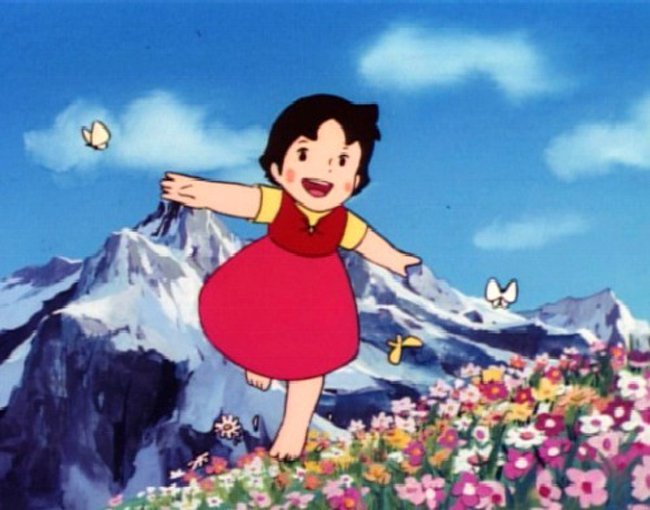
Prior to production, Takahata, Miyazaki, and Kotabe conducted groundbreaking on-site research in Maienfeld and Frankfurt in the summer of 1973, photographing landscapes, analyzing vernacular alpine architecture, and sketching livestock. This meticulous field research became the gold standard for the celebrated World Masterpiece Theater series.
Artistic Evolution and Global Cultural Impact
The 1974 anime broadcast sparked an international cultural phenomenon. Syndicated in dozens of languages across Europe, Latin America, Asia, and the Arab world, it revolutionized the artistic prestige of televised literary adaptations:
Pioneering Environmental Realism: The intricate recreation of alpine sunlight, seasonal foliage shifts, and detailed German cityscapes established the aesthetic foundation that would later define Studio Ghibli's cinematic style.
Iconic Musical Direction: Composed by Takeo Watanabe and featuring traditional Swiss yodeling and accordion melodies, the soundtrack remains one of the most recognizable themes in television history.
Maienfeld and Alpine Tourism: The global popularity of the franchise permanently reshaped the cultural geography of Maienfeld, leading to the creation of "Heididorf" (Heidi's Village), which continues to welcome tens of thousands of international tourists each year.
Verified Facts and Lesser-Known Trivia
The 1830 Adelaide Manuscript Connection: In 2010, Swiss literary scholar Peter Büttner discovered a 1830 novella titled Adelaide, das Mädchen vom Alpengebirge by German author Hermann Adam von Kamp, which features striking structural similarities to Spyri's 1880 narrative, shedding new light on the era's literary folklore.
Miyazaki's Early Location Scouting: Hayao Miyazaki's 1973 European research trip was one of the earliest instances of Japanese animators traveling overseas for systematic location hunting, establishing a working methodology that shaped modern feature animation.
The Cultural Symbolism of White Bread: In both the novel and anime, the soft white wheat rolls from Frankfurt represent a luxury that Heidi secretly stockpiles to bring back to Peter's blind grandmother, who could only chew dense alpine rye bread.
The Gravity-Defying Opening Swing: The celebrated introductory sequence featuring Heidi swinging high above the clouds was a deliberate artistic embellishment conceived by Miyazaki to capture the emotional essence of untamed childhood freedom.
Cultural Legacy and Enduring Relevance
Heidi stands as a monumental cultural legacy spanning more than 140 years of international acclaim. The story continues to champion timeless themes: environmental stewardship, mental well-being through nature, empathy for the disabled, and the restorative power of intergenerational community. Through theatrical films, museum exhibitions, and literary translations, Heidi remains the defining ambassador of Swiss hospitality and storytelling.
Frequently Asked Questions (FAQ)
Who wrote the original Heidi book and when was it published?
The book was written by Swiss novelist Johanna Spyri and published across two volumes in 1880 and 1881.
Who directed the famous 1974 animated series?
The classic anime series was directed by Isao Takahata, with scenic design by Hayao Miyazaki and character design by Yoichi Kotabe.
Where is Heidi's village located in real life?
The narrative is set in the alpine municipality of Maienfeld within the Canton of Graubünden, Switzerland.
Conclusion
Heidi remains a timeless celebration of childhood innocence, pastoral beauty, and universal kindness. Its enduring cross-cultural impact across literature and cinema proves that stories rooted in compassion and natural wonder speak to audiences across every era.
Referenced Sources
No comments yet. We invite you to share your perspective on this dispatch.
Conversation & Reader Perspectives (0)